

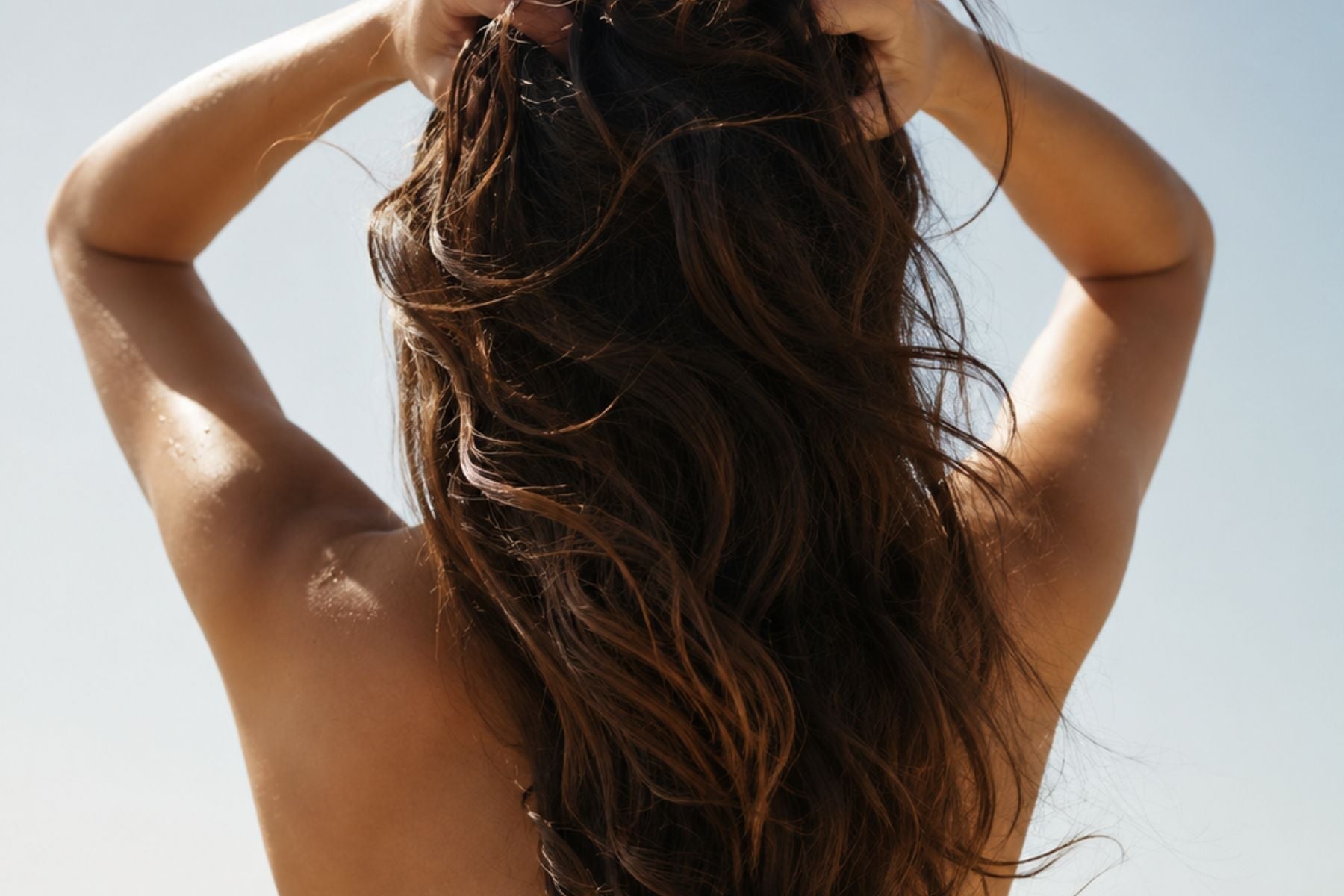
How to care for your hair after summer: look at what has changed
Chances are you looked after your hair this summer more than you think.
You used conditioner or a mask more often, protected it from the sun, rinsed it after the sea or the pool, tried to detangle it gently or paid more attention to ends you knew needed something extra.
And all of that counts.
Caring for your hair during the summer helps minimize the impact of weeks that are especially demanding for the hair fibre. But even when we do it well, the context changes: we spend more time outdoors, sun exposure increases, the sea and the pool come into play, the humidity changes, we tie our hair up more and we change our washing and styling habits.
That is why, when summer ends, your hair may feel different.
It does not necessarily mean it is "ruined" or that we have done something wrong.
It simply means it has been through a few different weeks.
And September may be a good time to review your routine and adapt it to how your hair is now.
The sun does not just change how your hair feels: it can alter the fibre itself
A recent experimental study published in the International Journal of Cosmetic Science analysed swatches of natural and bleached hair and found that intense, cumulative UV exposure can cause changes in both the cuticle and the cortex: increased oxidation, loss of surface hydrophobicity and changes related to protein integrity and the mechanical behaviour of the fibre.
At the highest level of exposure, some indicators were comparable to those seen after bleaching, although the two processes showed different damage profiles. This does not mean that spending a few days in the sun is the same as bleaching your hair: the study used an accelerated, controlled model intended to simulate roughly three months of intense sun exposure. The practical conclusion is clear: cumulative UV radiation can do more than reduce shine or increase the feeling of dryness; it can alter properties of the fibre itself. That is why, at the end of summer, it is worth observing how your hair behaves before deciding what it needs.
Before you change your routine, look at what has changed
- It may have lost shine
- You may notice drier mid-lengths or ends.
- It may tangle more, frizz more or break more easily.
- Or your hair may be fine, but your scalp is behaving differently
Each of these signs tells a different story.
That is why there is no single post-summer routine that works for everyone.
The interesting question is not only what treatment does it need?, but: what has changed, and what does it need now?
If it tangles more, think about friction
This is one of the most useful signs, and yet we rarely talk about it.
When the cuticle is more damaged and the surface loses some of its hydrophobicity, friction between the fibres can increase. Hair snags more, is harder to detangle and needs more strokes of the brush or comb.
And that can start a small vicious circle:
More tangles → More brushing → More friction → Greater risk of breakage.
That is why conditioning your hair is not just about making it softer.
Making it easier to glide and detangle also helps protect the fibre from mechanical damage.
If it has lost shine, it does not always need more product
Shine depends largely on how the surface of the hair reflects light.
A more even cuticle reflects light more uniformly and therefore gives a greater perception of shine.
Sun, chemical treatments, heat and mechanical aggressions can all help change that surface.
Before adding more products, check whether the loss of shine comes with heaviness, lack of movement or a feeling of build-up. If so, it may help to review how you cleanse. If not, the priority may be to improve conditioning and reduce friction.
More product does not always mean more care.
Your ends tell a different story
In long hair, an end may have been with you for years.
It has been through many more washes, brushings, hours of sun, hairdryers, colourings and rubbing than the centimetres of hair that have just grown next to the scalp.
So it is not surprising that this is precisely where we notice changes first.
And this reminds us of something important: not all of our hair has the same history.
The hair near the scalp and the ends that have been exposed for years do not necessarily need exactly the same care.
Applying conditioning and nourishing products where they are really needed, mainly mid-lengths and ends, can be much more effective than overloading all of your hair.

Coloured or bleached hair after summer
Coloured hair starts from a different structure.
Colouring, and especially bleaching, can alter the cuticle and other deeper structures. If we then add weeks of sun, pool water, sea, humidity or heat, it is reasonable to notice changes more easily at the end of summer.
That is why chemically treated hair may need a different care strategy, and it can help to temporarily cut back on excessive heat, improve conditioning and pay special attention to the areas that tangle or break most easily.
What if it is your scalp that has changed?
During the summer, sweating, washing frequency and the use of oils, leave-in conditioners or styling products may all increase. When you get back to your routine, some people notice build-up or roots that get oily differently; others, more dryness or discomfort.
Here it is worth separating two conversations we often mix up: the scalp and the hair fibre are not the same thing.
A mask can improve the feel of mid-lengths and ends, but it will not necessarily solve what is happening on the scalp.
Likewise, a shampoo chosen for the needs of the roots will not always provide all the conditioning that weakened ends need.
Understanding this difference and applying each product where it belongs makes it possible to build more precise routines. That is why it is worth learning to observe your scalp and hair.
How to adapt your hair care routine after summer
After weeks of greater exposure, the temptation is to start September by doing more.
We suggest starting by doing better:
1. Go back to a cleanse suited to your scalp.
If you notice heaviness, lack of movement or product build-up, an occasional deep cleanse may make sense. Afterwards, go back to gentle cleansing tailored to how your scalp is now, not necessarily to what it needed during the holidays.
2. Condition to reduce friction.
If your hair tangles more or feels drier, apply conditioner mainly to mid-lengths and ends and detangle gently. Making it easier to glide reduces the force needed to comb and helps limit mechanical damage.
3. Step up care where needed.
Long, coloured, bleached or particularly weakened hair may need a mask that provides more softness, slip and manageability. Not all of your hair needs the same amount or the same level of conditioning.
4. Minimize additional mechanical damage.
There is no need to give up your hairdryer or your styling. But it is worth moderating excessive temperatures, drying without rubbing, avoiding tugging and not keeping tight updos on wet hair for hours.
5. Do not judge your hair by a single day.
How your hair feels and behaves can vary with humidity, washing and the way you style it. Before changing your whole routine, check whether the change persists over several washes.

From cumulative exposure to the hair exposome
Environmental exposures, cosmetic procedures and daily handling do not all act in the same way, and not every combination has been studied. But they can add up over time on the same fibre.
This cumulative view is linked to a concept increasingly used in research: the hair exposome, which studies how the sum of environmental and everyday exposures can influence the properties of hair.
The fibre, once formed, does not age like living tissue, but it does accumulate wear from the moment it emerges until it reaches the ends. That is why caring for your hair is not about piling on treatments, but about understanding what has changed and responding appropriately.
Because in hair, too, what matters is the mark left by everything it has been through.
Leave a comment
This site is protected by hCaptcha and the hCaptcha Privacy Policy and Terms of Service apply.