

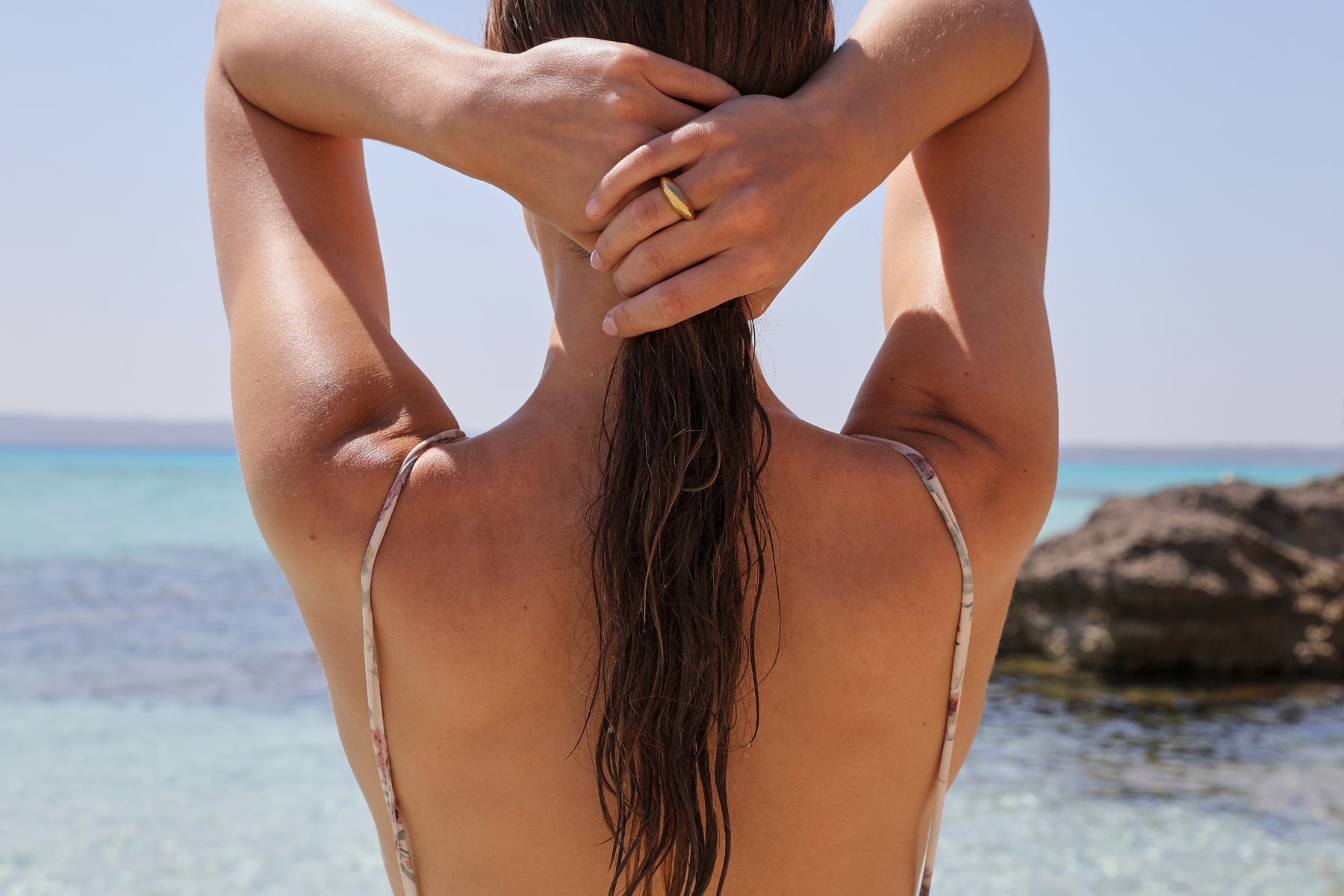
The best ways to protect your hair from the sun
Along with hats and scarves, a hair sun protector can protect your hair from the sun.

We all know how important it is to apply (and reapply!) sunscreen during those long, hot summer days to prevent skin damage. But did you know that the sun can also damage your hair?
"As well as changing the texture and colour of your hair, sun exposure can also lead to fragility and even breakage," says our founder Modesta, Doctor of Pharmacy.
Hair itself is a form of sun protection for the scalp, shielding it from burns, premature ageing, actinic keratosis and even cancer. Hair can suffer sun damage and, unlike skin, it doesn't hurt, but the damage becomes visible.
Today there are ways to keep your hair and scalp protected. In this post we explain how sun damage occurs in hair and how best to protect it while it's exposed to the sun.
How can the sun damage your hair?
One of the main functions of hair is protection: its structure shields the scalp from solar radiation, extreme temperatures and knocks.
When the sun's UV radiation hits your hair, it lightens it. You may have thought this lightening could be a good thing: who doesn't love natural blonde "highlights" after a few days at the beach? But we need to take care.
As well as changing the texture and colour of your hair, sun exposure can also lead to fragility and even breakage, which is why hair needs protecting from prolonged exposure to the sun.
Sun damage to hair is real. If your hair is exposed to the sun for long periods, UVA and UVB rays can damage the outer layer of the hair, the cuticle, leaving the cortex more vulnerable and damaging the keratins within it. The result? Loss of strength, elasticity, softness and shine, and a change in the tone of your colour.
This is how the sun can damage your hair:
If, after long periods in the sun, you notice your hair starting to feel drier, less even and brittle, it may be a sign that it's damaged. Prolonged heat and dryness can also cause more breakage and split ends over time, and encourage frizz.
It can change your hair colour
Even without colouring, your hair can change colour because of the sun. This is another sign that your hair is suffering from sun damage.
The sun's rays work by breaking down melanin, making hair look lighter and, if it's coloured, making the colour oxidize faster, bringing out unwanted tones that then need toning.
It's a widespread myth that prolonged sun exposure encourages grey hair: to date, there are no scientific studies showing that greater exposure to UV radiation can increase the number of grey hairs. Grey hairs appear when the melanocyte loses its ability to produce melanin.
What we can say is that stress encourages that loss of melanin and therefore the development of new grey hairs, which is why our advice is always to take action rather than worry.
Are certain hair types more vulnerable?
Although any hair type can be damaged, your hair may be particularly vulnerable to sun damage if it is fine and light in colour.
Finer, lighter hair lacks the thickness or pigment that could protect it from the sun's rays, whereas darker, thicker hair is usually better protected. Your hair is also more fragile and more prone to sun damage if it's very curly, and also if it's coloured in any way.
Remember that straighteners or hot rollers, chlorinated water in swimming pools or lightening your hair can make it more vulnerable to the stress of summer heat and sun. All of this can damage the hair's protein, keratin. This damage to its structure allows the sun and heat to penetrate the innermost structures of the hair more easily, resulting in more fragile hair.
Is a hair sun protector a good way to prevent hair damage?
We all know how important it is to protect our skin from the sun with a product offering minimum SPF (Sun Protection Factor) UVA and UVB protection, but does our hair need a sun protector for a summer day at the beach or in the mountains?
We protect the skin on our face and body from the sun with sunscreens containing UVA and UVB filters, and for hair there are also cosmetics that include these filters to provide maximum protection. They also contain antioxidant and nourishing active ingredients that protect the cuticle, minimizing damage and dryness.
If you don't have much hair, remember that your scalp will be exposed and hair sun protectors won't prevent damage to that area. Our recommendation is always to protect the area with hats or caps.
On areas without hair, you should apply the same sunscreen you use on your face or body, bearing in mind that, as it's an oily area, gel-type and oil-free textures will be more comfortable and effective.
How do hair sun protectors work?
Sun protection for hair works differently from sun protection for skin. Because our hair is made up of keratinized cells, it doesn't react to sun damage the way our skin does: visible redness, burning, peeling, etc. Hair needs a different approach.
Hair sun protection focuses on protecting the cuticle (the outer part of the hair), stopping the sun's rays from reaching deeper areas such as the cortex and medulla. Hair sun protectors don't prevent cellular damage the way regular SPF products do.
Hair sun protectors are cosmetics designed to give the hair cuticle maximum protection from UVA and UVB radiation, so that hair looks soft, manageable and shiny, and breakage is prevented.
The active ingredients in hair sun protection products usually include UV filters, antioxidants to fight free radicals and nourishing actives to counteract the damage caused.
Hair sun protectors are cosmetics with active ingredients that:
- Protect the hair thanks to their combination of UV filters
- Nourish the hair fibre making it more resistant to heat, UV radiation and repeated swims.
- Interact with the cuticle of the hair, creating a coating that protects its innermost and most vulnerable structures, such as the cortex.
- Have antioxidant properties that can neutralize the oxidation caused by free radicals, preventing damage to the hair's lipids and proteins.
At Modesta Cassinello, we always recommend combining them with:
- H08 Leave-in Conditioning Spray, pure innovation for giving your hair softness, protection and shine. It contains no sun filter, but its active ingredients protect against UV radiation, and it needs no rinsing.
- Use H10 Sublime Oil at the beach and by the pool: a selection of oils rich in antioxidants that will minimize damage from UV radiation and also from water.
Can I use a hair sun protector on my scalp?
As the scalp is part of the skin, if there is no hair protecting this area, it is advisable to apply a high-protection sunscreen, since the rays will hit it perpendicularly, and one that genuinely prevents the cellular damage caused by UV rays. As mentioned above, we always recommend light, gel-type, non-greasy, oil-free textures.
Other ways to protect your hair
Whether or not you use a hair sun protector, covering your head on hot, sunny days is your best line of defence against the sun's rays.
You can also protect your hair from sun damage by:
- Wrapping your hair in a scarf, wearing a wide-brimmed hat or using a parasol.
- Going out early or late in the day, just as you would to protect your skin.
- If you swim in a chlorinated pool, wearing a swimming cap or putting your hair up in a high bun to keep it dry. If your hair gets wet, make sure you rinse out the pool water, which contains chemicals such as chlorine, with clean water.
Summer is many people's favourite season and there's so much to enjoy. Don't let the sun's rays put a damper on your fun. Next time you head out into the sun, don't forget to protect your hair too.
Especially if your hair has already been damaged by heat and styling, adding an extra layer of protection with a hair sun protector can help prevent further breakage.
There's no such thing as too much protection for your skin and hair if you want healthy, beautiful hair this summer. And as well as protecting it during the sunny hours, we encourage you to give it the best rituals for its care. Here are our suggestions.
The best summer hair rituals

1. If you have an oily scalp:
Keep using treatment shampoos such as H07 Sea Salt Shampoo for effective cleansing, always combined with frequent-use shampoos such as H01 Frequent Use Shampoo or H05 Solid Shampoo to keep your scalp balanced.
Believing that oiliness decreases in summer is a mistake, just as it is with skin. Your hair may feel drier because of frequent washing, but remember that UVA radiation increases oil on the scalp. Not removing it can create "plaques" that stick to the scalp and can compromise the hair.
2. If you have a dry scalp that feels tight:
Choose more nourishing, gentle shampoos such as H02 Repairing Shampoo, a shampoo whose innovative formula allows delicate cleansing, instantly bringing comfort and softness to drier, more fragile scalps and hair prone to frizz and breakage.
3. If you're prone to irritation in summer and have a normal scalp:
We recommend H03 Shine and Vitality Shampoo. A shampoo for the whole family, free from fragrance, essential oils and allergens of any kind, for an effective, gentle wash whenever you like. It gently cleanses the scalp and hair, leaving a feeling of hydration and comfort on both.
And always after washing, whatever your hair type, apply a softening treatment to your mid-lengths and lengths. A conditioner or mask is the way to give your hair manageability, shine and protection. You can read about more benefits here.
Choose the softening treatment from our range that best suits your needs:
- H04 Revitalizing Conditioner. Hydrates without weighing hair down, every day.
- H06 Solid Conditioner. A different way to condition your hair.
- H08 Leave-in Conditioning Spray. Extra softness.
- H09 Mask. Deeply nourishes.
- H10 Sublime Oil. Flash effect, softness, shine and frizz control.
Leave a comment
This site is protected by hCaptcha and the hCaptcha Privacy Policy and Terms of Service apply.