

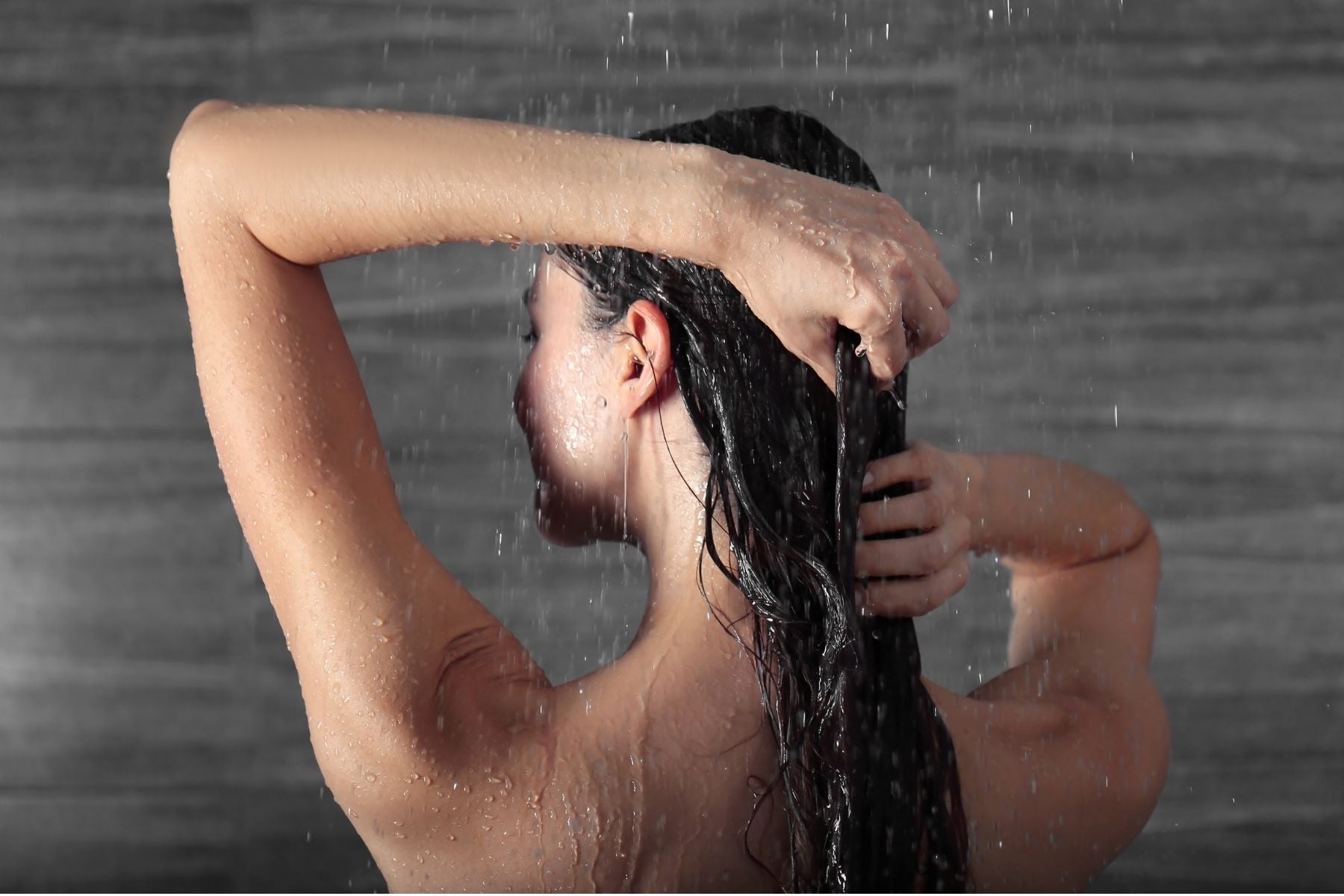
Does more hair fall out when you wash it? What really happens in the shower
Some days an ordinary shower leaves a worrying picture: hairs in your hands, in the comb and in the drain. The immediate reaction is usually to think that the shampoo, the conditioner or the washing itself has caused the hair loss.
However, washing is usually the moment hair loss becomes visible, not necessarily the moment it begins.
Three different things can happen in the same shower:
- Hairs that were already ready to shed at the end of their cycle.
- Shed hairs that had been held in place among the rest of your hair.
- Fragments of hair fibre that have broken off during washing or detangling.
They all end up in the drain, in your hands or in the comb, and they can all make us perceive less density, but they do not have the same origin or need the same approach.
This article expands on a conversation published in Telva about the myths surrounding hair loss when washing, and about when it can make sense to apply conditioner before shampoo. Here we look more closely at what we are really seeing in the shower and how to tell shedding apart from breakage of the fibre.
Why does it seem that more hair falls out when you wash it?
Hair is formed in the hair follicle and goes through different stages of growth, transition, rest and shedding. A hair in the active growth phase should not come away from the follicle during a normal wash.
Frequent washing, done with the right technique and a suitable formula, does not make a healthy hair in its growth phase come away from the follicle. Most of the hairs that appear in the shower were already ready to shed. If there is abnormal hair loss, the cause has already acted on the follicular cycle beforehand; washing only makes it visible.
In addition, when you leave longer between washes or brushing, some of those hairs stay held among the rest of your hair. At the next wash they appear all at once, and the amount can look much more alarming. In fact, clinical tests that analyse hair shed during washing must carefully standardize the time since the previous wash, because that interval changes the amount observed.
Washing regularly spreads those hairs over several washes and reduces the build-up effect, but it does not make more or less hair fall out as a result of its cycle.
That is why a single shower is not enough on its own to judge whether there is abnormal hair loss. It is more useful to observe whether there has been a clear change from your usual pattern and whether you are also noticing a gradual loss of density.
Hair loss and breakage are not the same thing
When a hair sheds from the follicle, we usually see a whole strand, roughly the same length as the rest of your hair. With breakage, we see fragments of different lengths, split ends, uneven tips and greater difficulty keeping length.
Short hairs should not automatically be read as breakage. Within the same head of hair, not only do hairs at different points of the cycle coexist: follicles also differ physiologically in growth rate, thickness and length of the anagen phase, so not every hair reaches the same potential length. Length alone does not tell us whether we are looking at a new hair, one whose growth ended earlier or a broken fibre.
The fundamental difference is where it comes from. Hair loss depends on the biological cycle of the follicle. Breakage happens to the hair fibre, which is made of keratinized cells and cannot regenerate biologically once it has emerged from the scalp. We can, however, condition it, reduce friction and protect it so that it keeps its integrity better.
A hair that breaks has not fallen out of the follicle, but the mirror counts both as a loss of density.

Does conditioner cause hair loss?
Under normal conditions, no. Conditioner does not make a hair in its growth phase come away from the follicle. Its main action is on the fibre: it reduces friction between hairs, makes detangling easier and reduces the force we need to use when combing.
When you apply conditioner and run your fingers, comb or brush through, hairs that were already ready to shed but had stayed trapped among the rest can be released. This explains why we may see more hairs in our hands at precisely that moment without the product having caused them to fall out.
The most recent research confirms that certain cationic agents used in conditioners significantly reduce the force needed to comb wet hair. The European consensus on hair ageing published in 2026 also recognizes the usefulness of cationic polymers, hydrolysed proteins and silicones in improving the cosmetic quality and manageability of the fibre.
In long, curly, bleached, coloured or weakened hair, routinely skipping conditioner can encourage knots, increase pulling during detangling and cause more breakage.
Conditioner does not make your hair fall out: it reveals the hair that was already ready to shed and helps protect the hair that remains from friction and breakage.
Does washing your hair every day increase hair loss?
There is no universal washing schedule. The right frequency should be adapted, above all, to the needs of the scalp and can vary with sebum production, sweating, exercise, dandruff or the use of styling products.
An oily scalp may need washing every day or almost every day. A curly, dry or very porous fibre usually needs more conditioning and a washing routine adapted to avoid adding dryness or friction. This does not necessarily mean that everyone with curly hair should go long periods without washing their scalp.
Frequent washing, done with the right technique and a suitable formula, does not make a healthy hair in its growth phase come away from the follicle. In telogen effluvium, leaving longer between washes out of fear does not stop the process either: on the day you wash, more of the hair that had been held in place over the previous days appears.
What can increase breakage is repeatedly washing with a formula unsuited to the fibre, rubbing the lengths, detangling roughly or applying excessive heat after every wash. But that is damage to the hair shaft, not an increase in hair loss from the follicle.
How to wash your hair to reduce friction and breakage
A good washing technique cannot prevent androgenetic alopecia, telogen effluvium or any other disruption of the follicular cycle. It can, however, prevent a visible loss of density caused by deterioration of the fibre from being added to that hair loss.
-
Wet your hair thoroughly before applying shampoo
Water helps spread the formula and lets you cleanse with a reasonable amount of product. Distribute the shampoo between your hands and apply it mainly to the scalp. -
Massage with your fingertips, not your nails
Work the shampoo in with gentle, well-directed movements, without scratching or putting unnecessary pressure on the scalp. -
Do not pile your lengths on top of your head
In a normal wash, the lather that runs down during rinsing is usually enough to cleanse the lengths. Repeatedly rubbing hairs against each other increases friction and wears down an already weakened cuticle. -
Apply conditioner where the fibre needs it
A conventional rinse-off conditioner is spread from mid-lengths to ends, focusing on the longest, most porous or most damaged areas. The roots are avoided not because conditioner can cause hair loss, but because not all formulas are designed to be applied to the scalp, and some can leave residue or reduce volume, especially in fine hair.

-
Detangle from the ends
While the conditioner is working, you can detangle your hair in sections, starting at the ends and gradually working upwards. You can use your fingers, a wide-tooth comb or a detangling brush with flexible bristles.
The best tool is not necessarily the one that promises to detangle fastest, but the one that lets you release knots without dragging the hair or forcing you to pull.
For straight or wavy hair, it is usually helpful to gently remove knots before washing.
For very curly or textured hair, it is usually less aggressive to detangle when wet and with enough conditioner to provide slip.
- After washing, remove excess water by pressing, without rubbing vigorously with the towel. Use the hairdryer at a moderate temperature and do not hold it too close to the fibre.
When can it make sense to apply conditioner before shampoo?
In long, bleached, porous or weakened hair, applying conditioner to the lengths before a deeper cleanse can provide slip and reduce friction during washing. It is not an anti-hair-loss technique or a step everyone needs: it should be kept for the hair and the washes that really need that extra protection.
As we explained in Telva, the order of application should not simply follow a trend, but the needs of the scalp and the condition of the fibre.
The mistakes that most encourage breakage
Breakage rarely comes from a single action. It is usually the result of small, repeated aggressions on a fibre that may already be weakened by length, colouring, bleaching, sun or heat.
Among the most common mistakes are:
- Rubbing and piling up the lengths while washing.
- Scratching the scalp with your nails.
- Repeatedly running a deep-cleansing shampoo through porous ends.
- Skipping conditioner when the fibre tangles or is damaged.
- Trying to remove a knot from the root, moving all the tension down to the ends.
- Rubbing or twisting your hair with the towel.
- Keeping it tied up, tight and wet for long periods.
- Overusing high temperatures.
- Repeatedly wearing very tight hairstyles, which as well as breakage can put sustained traction on the follicle.
Should you look for an anti-hair-loss shampoo or conditioner?
I would not choose a shampoo or conditioner because of an anti-hair-loss promise. Rinse-off products have not been shown to stop hair loss of follicular origin on their own.
A review published in 2025 analysed the ingredients that manufacturers of trichological shampoos presented as active against hair loss. Most had not been evaluated individually in clinical trials and, when they appeared in complex formulas, the observed result could not be attributed to them separately. The presence of caffeine, biotin, rosemary, peptides or plant extracts does not automatically turn a wash product into a treatment for alopecia.
That is why, at Modesta Cassinello, we do not call our shampoos or conditioners "anti-hair-loss". Their job is a different one: to cleanse the scalp effectively and gently, and to protect the fibre against friction, knots and breakage.
When it is necessary to act on the follicle, the cause must be identified first, and leave-on treatments used with active ingredients, concentrations and regimens studied for that specific condition. Not every serum called "anti-hair-loss" has evidence behind it simply because it stays on the scalp.
Nor would I draw up a universal blacklist of sulphates, silicones or alcohols. What matters is the formula as a whole, the hair type and individual tolerance. Any product that repeatedly causes itching, burning, redness or flaking should be stopped and assessed.
In a shampoo, I would look for cleansing suited to the scalp; in a conditioner, less friction and breakage in the lengths. I would not choose either because of an isolated promise of growth.
When should you seek advice about hair loss?
Rather than obsessively counting the hairs that appear in a shower, it is better to observe whether there has been a change from what is usual for you.
It is advisable to see a dermatologist if you notice:
- A sudden or persistent increase in hair loss.
- A gradually widening parting.
- A ponytail that is getting thinner or a visible decrease in density.
- A patch or area that is clearly sparse.
- Marked loss of eyebrows or eyelashes.
- Intense itching, pain, burning, inflammation or significant flaking of the scalp.
Gradual loss of density, a widening parting, a thinner ponytail, localized patches and certain scalp symptoms can be signs of different forms of alopecia and need proper assessment.
Changing shampoo without identifying the cause may improve how your hair feels cosmetically, but it will not necessarily solve what is happening in the follicle.
Hair care does not end with washing. During periods of greater nutritional demand, insufficient diets or factors such as stress and life changes, a food supplement can be considered as support within an overall strategy. Hair Boost, the food supplement we have developed at Modesta Cassinello, provides, among other nutrients, zinc and selenium, which contribute to the maintenance of normal hair. It does not replace the diagnosis or treatment of hair loss when these are needed.
Related reading: Hair supplements: what they are for, when they can make sense and how long they need.
What washing can, and cannot, do
A suitable wash can:
- Cleanse the scalp and remove sebum, sweat, shed skin cells and residue.
- Make visible the hairs that were already ready to shed.
- Reduce friction, knots and breakage through the right technique and conditioning.
- Help us maintain a routine adapted to the needs of the scalp and the fibre.
Washing cannot:
- Reprogramme the follicle's cycle.
- Prevent androgenetic alopecia.
- Stop telogen effluvium on its own.
- Turn any shampoo or conditioner into an anti-hair-loss treatment.
The hair we see in the shower can give us information, but it is not a diagnosis in itself. We need to look at the whole picture: how much it has changed from what is usual, how density is evolving, what the lengths look like and what condition the scalp is in.
Washing makes hair loss visible; it does not treat it. Cosmetics protect the scalp and the fibre, while diet, supplementation where appropriate and specific treatments act at other levels.
Selected references
- Li X. et al. Hair Shedding Evaluation for Alopecia: A Refined Wash Test. Clinical, Cosmetic and Investigational Dermatology, 2022.
- Milner Y. et al. Exogen, shedding phase of the hair growth cycle. Journal of Investigative Dermatology, 2002.
- Śpiewak R. Ingredients of Trichological Shampoos with Alleged Beneficial Effects on Hair—What Is Really Known About Their Efficacy? Cosmetics, 2025.
- Tham HP. et al. Electrokinetic analysis reveals common conditioner ingredient interactions with human hair. International Journal of Cosmetic Science, 2026.
- Saceda-Corralo D. et al. Hair Aging Revisited: An Expert Delphi Consensus on Pathogenesis, Clinical Features, and Future Therapies. Dermatology and Therapy, 2026.
- American Academy of Dermatology. Recommendations on washing, conditioning, detangling and preventing hair damage.

Each article is backed by the expertise of our founder and CEO Dr. Modesta Cassinello, Doctor of Pharmacy and Diploma in Nutrition, committed to excellence in skin and hair care.
Leave a comment
This site is protected by hCaptcha and the hCaptcha Privacy Policy and Terms of Service apply.