

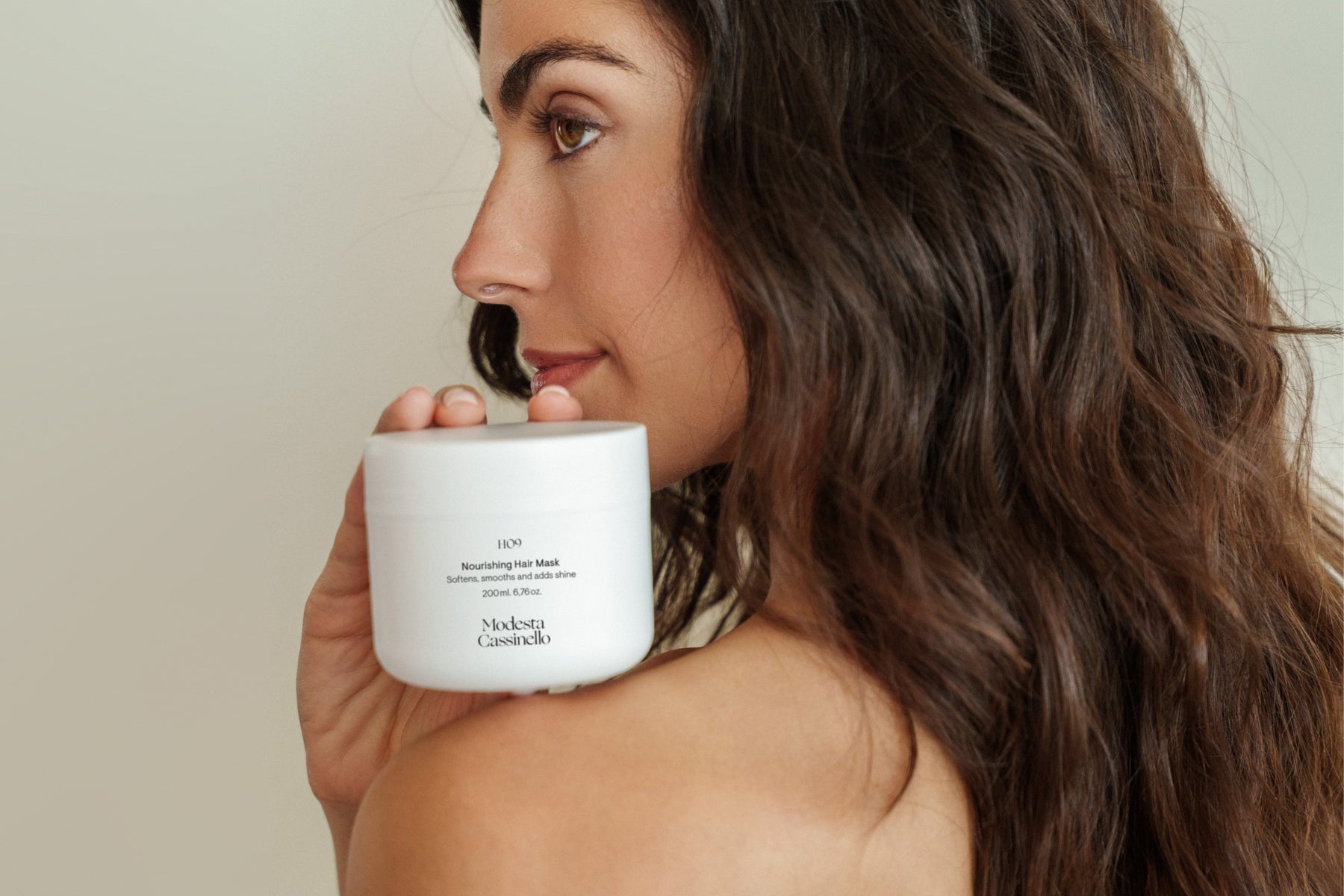
How to Choose a Nourishing Mask That Doesn't Weigh Your Hair Down
How to choose a formula that nourishes without weighing hair down
When your hair feels dry, dull, frizzy or hard to detangle, we tend to look for a "moisturizing" mask because we associate hydration with softness and lightness. The word "nourishing", on the other hand, can make us think of a dense, greasy formula that might flatten volume.
However, with dry or damaged hair, adding moisture doesn't solve everything. And a nourishing mask doesn't have to leave hair heavy when its ingredients are well chosen, well dosed and well combined.
The key lies in the balance between humectants, lipids, emollients and conditioning agents. A good formula should improve softness, slip and manageability without leaving a greasy feel after rinsing.
That's why, when choosing a mask, it isn't enough to ask whether it moisturizes. It also matters how it makes detangling easier, whether it reduces friction, whether it improves the look of mid-lengths and ends, and whether it lets hair keep its movement.
The new H09 Nourishing Mask was created with precisely this approach: a formula with a biomimetic lipid complex, humectants, conditioners and light emollients to care for hair without silicones and without an overly heavy feel.
What a good hair mask should provide
A good hair mask should respond to several needs at once.
Its role isn't just to provide instant softness. It should also make detangling easier, improve the flexibility of the fibre, help control frizz and reduce friction when styling.
After rinsing, your hair should feel:
- Softer to the touch.
- More flexible.
- Easier to detangle.
- Less rough.
- More evenly shiny.
- Nourished, but with movement.
The right result isn't the one that leaves the most product feel, but the one that makes your hair behave better without looking weighed down.

Hydration and nourishment: why hair may need both
Although in hair care we often use the words hydration and nourishment as if they were interchangeable, they describe different functions within a formula.
Moisturization relates to ingredients that can attract or retain water, such as glycerin, propanediol, betaine or panthenol. These components help the fibre feel more flexible and less stiff.
Cosmetic nourishment is mainly associated with lipids and emollients that lubricate the surface, improve the feel and provide softness and slip.
Added to these functions is conditioning, which makes detangling easier, reduces static and limits friction between fibres.
That's why hair that is dry, dull, frizzy or damaged by colouring, sun or heat tools may need more than water or oil: it needs a formula that can combine moisturization, conditioning and lipids in a balanced way.
Why hair becomes rougher and harder to detangle
Sun exposure, colouring, bleaching, frequent use of hairdryers or straighteners, repeated washing and everyday friction can gradually alter the surface of the hair fibre.
When the cuticle's surface is less regular, the fibres glide less smoothly over one another. Hair tangles more easily, is harder to comb, frizz increases and light is reflected less evenly.
A suitable mask should help lubricate that surface and reduce resistance to slip. That's why the feeling of softness isn't just a sensory matter: hair that detangles more easily is also subjected to less pulling and friction when styling.
Which ingredients to look for in a mask for dry or damaged hair
A quality hair mask should combine different types of ingredients, each with a different and complementary role.
Biomimetic lipids
Ceramides, cholesterol and fatty acids are part of an approach inspired by certain components of the hair's lipid architecture.
Their cosmetic role is to help improve lubrication, evenness and the feeling of cohesion of the fibre, especially on mid-lengths and ends.
In the article "Hair biomimetics: when a mask takes its inspiration from the lipids of healthy hair" we explain in more detail how this approach works and why H09 isn't simply a mask with oils.
Humectants
Ingredients such as glycerin, propanediol, betaine and panthenol help hair feel more hydrated, flexible and comfortable.
Light emollients
Squalane, hemisqualane, jojoba and certain plant esters help provide softness, slip and shine without leaving a heavy feel.
Hair conditioners
Conditioning agents make detangling easier, improve combability and help reduce static.
A mask's effectiveness doesn't depend on a single family of ingredients, but on how they are combined to achieve an even, functional deposit that is easy to rinse out.
Is a mask with or without silicones better?
Silicones are a broad family of ingredients and they don't all have the same properties. They can provide slip, shine, protection and a feeling of instant softness.
So a mask isn't better or worse simply because it does or doesn't contain them. What matters is the overall performance of the formula and the finish you want to achieve.
A silicone-free mask can be a good choice for those who prefer conditioning based on lipids, emollients, polymers and cationic agents, or who are looking for natural-looking shine and a light feel.
H09 Nourishing Mask does not contain silicones. Its formula uses a biomimetic lipid complex, conditioners and emollients with different spreadability to provide softness and slip without relying on them for the result.
H09 Nourishing Mask: nourishment adapted to your hair
H09 Mask is an intensive treatment for dry, dull, frizzy or damaged hair.
Its formula is designed to improve softness, detangling, slip, flexibility, natural shine and evenness from mid-lengths to ends.
It can be especially useful for coloured or bleached hair, hair exposed to the sun or regularly styled with heat tools. It can also be added to the routine of normal hair that needs a visible improvement in feel and finish.
What makes it different isn't packing in a large amount of oils, but combining a biomimetic lipid system with humectants, conditioners and light emollients.

Which hair types is it recommended for?
H09 Nourishing Mask could be a good fit for your routine if:
- Your hair feels dry, dull or lacking in softness.
- It tangles or breaks more when you brush it.
- You need to control frizz.
- Your mid-lengths and ends are damaged by colour, sun or heat.
- You're looking for a silicone-free nourishing mask.
- Your roots get oily, but your ends need more care.
- You want to alternate it with H04 Conditioner as more intensive care.
The amount and frequency should be adapted to the thickness, porosity and condition of your hair.
How to apply H09 Mask to avoid using too much product
A mask's result doesn't depend only on the formula. How you use it is also decisive.
After rinsing out your shampoo, apply a small amount to your mid-lengths and ends. Spread it with your fingers or a suitable brush, focusing on the areas that are roughest or most prone to tangling. Leave it on for 5 to 10 minutes and rinse thoroughly.
On fine hair, start with a small amount and avoid bringing it needlessly close to the roots. On thick, porous or very damaged hair, you may need to use a larger amount.
You can use it whenever your hair feels drier and you want to give it a change.
A mask doesn't weigh hair down just because it's nourishing. Heaviness can also appear when too much is applied, when it's spread on areas that don't need it or when it isn't rinsed out sufficiently.
Does H09 replace conditioner?
For normal washes, you can use H04 Revitalizing Conditioner to quickly soften, detangle and improve the finish of your hair.
H09 Nourishing Mask offers a more intensive treatment. On the days you use it, there's no need to use conditioner.
If your hair is very dry, thick or porous, or at times when your hair suffers more from UV radiation, swimming pools or the sea, you can use it continuously.
The best mask is the one that leaves hair better, not more coated
The best moisturizing mask for dry hair isn't necessarily the densest one or the one that leaves the most product feel. It's the one that makes your hair softer, more manageable and more luminous without losing lightness.
H09 Nourishing Mask combines biomimetic lipids, humectants, conditioners and light emollients to adapt nourishment to the needs of the fibre.
Because nourishing hair properly isn't about adding weight.
It's about giving it what it needs to move again, reflect light and respond naturally to styling.
FAQs
What is the best moisturizing mask for dry hair?
The best moisturizing mask for dry hair is one that provides softness, nourishment and detangling without leaving hair heavy. Look for formulas with humectants, lipids, ceramides and light emollients, especially if your hair is dull, frizzy or damaged.
How many times a week should I use a hair mask?
It's usual to use a hair mask once or twice a week. On very dry or bleached hair, or hair frequently exposed to the sun, hairdryers or straighteners, weekly use can be maintained on an ongoing basis.
Can a moisturizing mask weigh hair down?
Yes, a mask can weigh hair down if the formula is too heavy, if too much is applied or if it's used on the roots when the scalp tends to be oily. To avoid this, apply the mask only to mid-lengths and ends and rinse thoroughly.
What's the difference between conditioner and a mask?
Conditioner is designed to quickly soften and detangle after washing. A mask is a more intensive treatment, recommended once or twice a week, to provide more nourishment, softness and manageability.
Can H09 Nourishing Mask be used on coloured or bleached hair?
Yes. H09 Nourishing Mask is suitable for coloured or bleached hair. It's especially useful when coloured hair feels drier or duller, has damaged ends or is harder to detangle.
Does H09 Nourishing Mask contain silicones?
No. H09 Nourishing Mask does not contain silicones. It uses biomimetic ceramides, lipids, squalane, hemisqualane, jojoba and plant esters to provide softness, slip and natural-looking shine without a heavy feel.
Leave a comment
This site is protected by hCaptcha and the hCaptcha Privacy Policy and Terms of Service apply.